
Human-in-
the-Loop
AI moves at machine speed; judgment and accountability belong to a person. Augmented human-in-the-loop validation keeps both - the AI does the analysis, a named subject-matter expert makes the final call. Faster than manual review, safer than full autonomy.
What is human-in-the-loop validation?
Augmented, human-in-the-loop (HITL) validation follows one pattern: AI analyzes, a human validates, the system executes. The AI does behavioral analysis, risk scoring, and anomaly detection at machine speed; a named subject-matter expert (SME) applies judgment and makes the final go/no-go before any consequential action runs.
It is faster than pure manual review and safer than pure autonomous execution - and a named human is always accountable. The machine surfaces the evidence; the person owns the decision.
High-risk changes route to a named expert
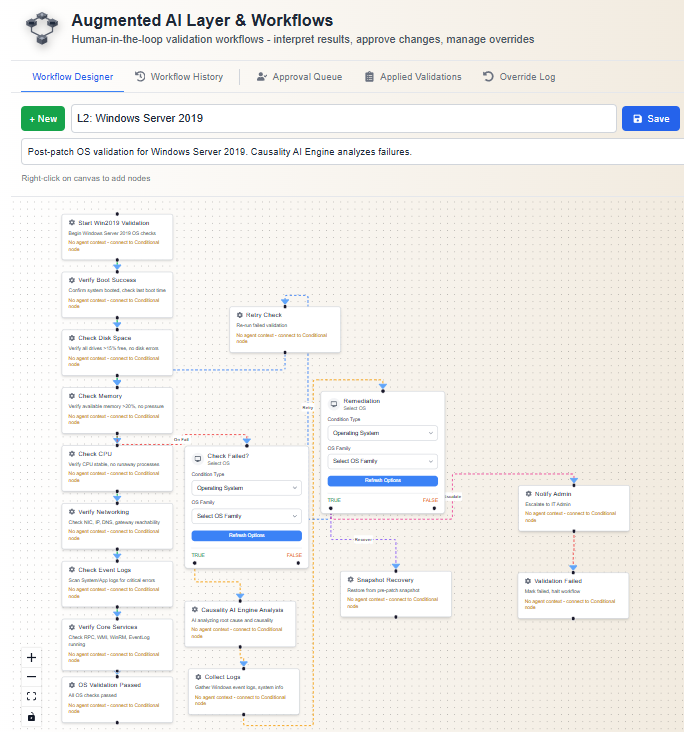
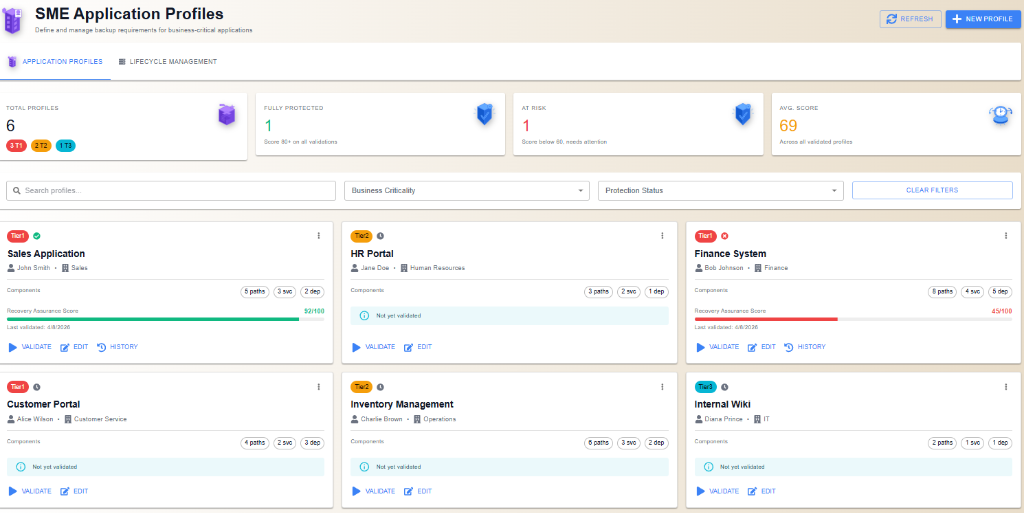
When a change is consequential enough to need human judgment, Keystone routes it to a named SME through the Workflow Designer. The SME sees AI-synthesized risk scores, behavioral comparison results, and every prior gate outcome in one place - then makes an informed go/no-go.
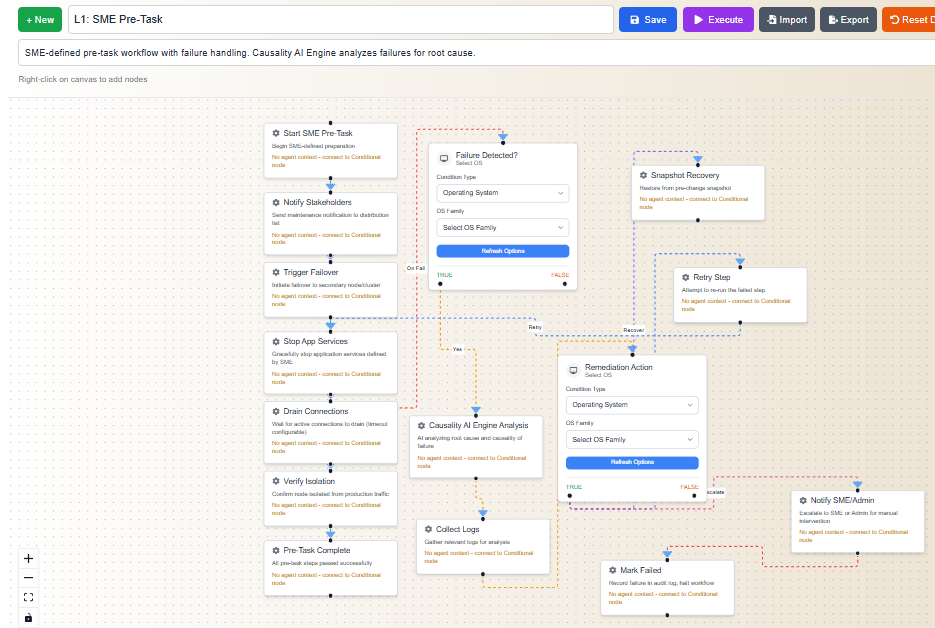
SMEs design conditional logic workflows - pre-tasks, validation checks, and automatic remediations if a change fails - that turn their tribal knowledge into enforced, repeatable automation. They define it once; Keystone enforces it every time.
A named human is always on the record
Every AI-generated assessment and the named human's approval are logged together - a complete, traceable chain of who approved what and why, even when an AI agent proposed the change.
This is how accountability survives at machine speed. The AI's analysis informs the decision; it never replaces the person who owns it. When the question is "who signed off?", there is always a name and the evidence behind it.
for routine changes - analysis, risk scoring, and anomaly detection run at machine speed.
where it matters - a named SME makes the final go/no-go on consequential changes.
accountable per consequential change - logged alongside the evidence behind the call.
See how SME approval fits the full eight-gate sequence in Change Validation.
Human-in-the-loop oversight is moving from principle to requirement
The urgency is documented in both operations and regulation. Gartner, summarized by Itential, predicts human-in-the-loop oversight in IT operations workflows will fall from 95% in 2025 to 40% by 2028 as agentic autonomy scales. The same analysis says enterprises are already seeing AI agents execute write operations against production systems with no human-in-the-loop checkpoint.
The regulatory standard is becoming equally concrete. As outlined in Digital Applied's review of the EU AI Act and NIST AI RMF, enforcement of the EU AI Act's high-risk-system obligations takes effect August 2, 2026. Article 14 requires human-machine interface tools that let a person interpret outputs and intervene, stop, or override, while NIST calls for human oversight that is trained, measurable, and provable.
Strata's 2026 guide describes HITL as trained humans retaining decision authority over high-risk agent actions, with timely context, authority to intervene, and a defensible rationale. Yet Arthur.ai's review of agent governance platforms notes that eight vendors launched agent governance tooling at RSAC 2026 and none solved the cross-platform oversight problem. The requirement is well documented; consistent enforcement remains the gap.
Gate 7 makes the checkpoint structural, not negotiated
Digital Applied makes the key distinction: the checkpoint gate must be structural, enforced by the system around the model rather than negotiated by the model. Keystone implements that pattern through the Workflow Designer and Gate 7. Within the existing eight-gate pipeline, a high-risk change and every prior gate outcome route to a named SME for a recorded go/no-go before the change can proceed.
Human-in-the-loop remains Keystone's primary model and product term. Human in the Middle (HITM) is AuthorityGate's own name for this enforced Gate 7 SME checkpoint: the person is not merely available for consultation, but placed in the execution path with the context and authority to stop the action.
What is Human in the Middle (HITM)?
Human in the Middle (HITM) is AuthorityGate's name for Keystone's Gate 7 SME checkpoint: a structural, system-enforced approval gate in the execution path, not an optional advisory step. A named subject-matter expert reviews AI-synthesized risk evidence and every prior gate outcome, then records a go/no-go before a high-risk change can proceed.
Generic human-in-the-loop
Advisory and unenforced. A human may be loosely in the loop without being placed in the execution path; review and logging vary, and the workflow can continue without consistent approval evidence.
Keystone's HITM / Gate 7
Structural and enforced by the system around the model. A named SME receives full risk and prior-gate context, and the recorded go/no-go is logged before execution; the checkpoint cannot be bypassed or negotiated away.
This comparison applies Digital Applied's structural, not negotiated distinction to Keystone's Gate 7 implementation.
Human-in-the-loop, answered
What does human-in-the-loop mean in AI validation?
Human-in-the-loop (HITL) validation is an augmented model where AI and a person each do what they do best: the AI analyzes, a human validates, and the system executes. The AI performs behavioral analysis, risk scoring, and anomaly detection at machine speed; a named subject-matter expert (SME) then applies judgment and makes the final go/no-go before any consequential action runs. It is faster than pure manual review and safer than pure autonomous execution - and a named human is always accountable for the decision.
When does a change escalate to a human?
Routine, low-risk changes can flow through Keystone's automated gates at machine speed. A change escalates to a named SME when it is high-risk - when AI-synthesized risk scores, behavioral comparison results, or prior gate outcomes indicate the change is consequential enough to require human judgment. Keystone routes those changes to the right expert through the Workflow Designer, so the human is in the loop exactly where it matters and nowhere it doesn't.
What is the Workflow Designer?
The Workflow Designer is where SMEs turn tribal knowledge into enforced, repeatable automation. An SME designs conditional logic workflows - pre-tasks, validation checks, and automatic remediations to run if a change fails - once, and Keystone enforces them every time. When a high-risk change routes to that SME for approval (Gate 7), they see AI-synthesized risk scores, behavioral comparison results, and every prior gate outcome in one place, then make an informed go/no-go.
How is accountability preserved when AI acts at scale?
Every AI-generated assessment and the named human's approval are logged together - a complete, traceable chain of who approved what and why, even when an AI agent proposed the change. The AI's analysis does not erase human accountability; it informs it. Because a named SME signs off on every consequential action and that decision is recorded alongside the evidence the AI produced, accountability survives at machine speed instead of dissolving into it.
Why is human-in-the-loop oversight now an urgent industry-wide conversation?
Agent autonomy is increasing while regulatory deadlines and operational evidence are making oversight concrete. Gartner predicts human-in-the-loop oversight in IT operations workflows will fall from 95% in 2025 to 40% by 2028, and reports that enterprises are already seeing AI agents execute write operations against production systems without a human checkpoint. On August 2, 2026, enforcement of the EU AI Act's high-risk-system obligations takes effect, including Article 14 requirements for tools that let people interpret, intervene, stop, or override. NIST also calls for human oversight that is trained, measurable, and provable.
Sources: Gartner Predicts 2026 summary from Itential; EU AI Act Article 14 and NIST overview from Digital Applied
How does Keystone's Gate 7 differ from a human-in-the-loop checkbox?
The industry calls the pattern human-in-the-loop. AuthorityGate calls Gate 7 its Human in the Middle (HITM) checkpoint: an enforced implementation of HITL inside Keystone's eight-gate pipeline. The Workflow Designer places the approval in the execution path, routes a high-risk change and its prior gate evidence to a named SME, and requires a recorded go/no-go before the change can proceed. The checkpoint is structural and enforced by the system around the model, not a prompt or policy the model can negotiate away.
Sources: Human-in-the-loop escalation design from Digital Applied; Strata's 2026 guide to human-in-the-loop
Keep the human in the loop - and on the record
Human-in-the-loop SME approval is one capability of AuthorityGate Keystone. Join the invitation-only Founding Members Early Access Program and put a named expert behind every consequential change.