
The AI Change
Governance Field Manual
A CISO operating guide for keeping human authority, technical proof, and recovery ahead of autonomous changes moving at machine speed.
Do not try to make a human review board run at machine speed. Turn policy into automated gates: let low-risk actions pass only with proof, stop consequential actions for a named human, and make recovery evidence a condition of execution.
What is AI change governance?
Autonomous AI change governance is the operating system of policies, identity controls, technical validation, human escalation, audit evidence, and recovery controls that decides whether an AI-initiated action may execute. It closes the gap between a policy that says what should happen and a production control that proves what may happen.
AI deployment is outrunning control
Three current industry studies point in the same direction: enterprises are adding agents faster than they are building identity strategy, governance systems, visibility, and lifecycle controls.
Deployment vs. governance
Using agentic AI
59%Governance systems
26%33-point gap between reported agentic use and governance capability.
Survey: 4,500 executives, 19 countries, 12 industries.
Read the primary sourceAgents vs. identity strategy
Using AI agents
91%Developed NHI strategy
10%Identity is the control plane. An agent without governed identity cannot have governed authority.
Vendor research based on a survey of 260 executives.
Read the primary sourceVisibility and incident reality
unknown agents
agent incident
formal retirement
Reported incident impacts
418 IT and security professionals. Commissioned by Token Security; sponsor and methods disclosed by CSA.
Read the primary sourceApproval, vendor trust, and recovery each leave a different gap
Each existing discipline does valuable work. The gap appears when authorization is treated as proof, vendor assurance is treated as local compatibility, or data recovery is treated as uninterrupted business operation. Keystone connects those controls with independent validation before impact.
| Today's control | What it proves | What remains unproven | Keystone adds |
|---|---|---|---|
GAP 01 ITSM, CAB, and human approval | Establishes intent, ownership, schedule, communication, and accountable authorization. | Whether the exact payload will behave safely on the exact target, with its live dependencies, at execution time. | Bind the approved ticket to actor, operation, target, window, technical evidence, and a pass/hold/block decision. |
GAP 02 Vendor QA, signatures, and release notes | Establishes provenance and shows the vendor tested the product against its supported conditions. | Whether the vendor change is safe against your configuration, dependency graph, extensions, data, and known-good behavior. | Verify provenance, scan the artifact, test behavior in a representative environment, stage the rollout, and watch for drift. |
GAP 03 Backup, replication, and disaster recovery | Protects recoverability and gives the organization a trustworthy path back after loss or corruption. | Whether the change should run, whether the service remains operational, and how long customer, revenue, and brand effects will last. | Prevent avoidable impact before production while preserving verified backup and rollback as required recovery evidence. |
Positioning: Keystone is not an ITSM, vendor-QA, observability, backup, or disaster-recovery replacement. It makes their evidence enforceable at the point where a proposed change becomes production impact.

Restoring data and restoring the business are not the same finish line
Data resilience is essential: it protects clean, recoverable information. Operational resilience asks the next question: was impact prevented, did the service remain usable, and how long did the wider business continue absorbing the event? Operational Data Resilience requires both.
466 cyber-related plus 456 application/infrastructure hours for a typical Global 2000 company.
Splunk and Oxford Economics, 2024. Aggregated across many systems; not 922 hours of enterprise-wide blackout.About $900,000 per hour and $300 million annually per Global 2000 organization.
Splunk, 2026; survey of 2,000 Global 2000 executives.Average share of affected data recovered after ransomware; only 28% fully restored data.
Veeam, 2026; more than 900 senior IT, security, and risk leaders.Share reporting each outcome, Veeam 2025
Recovered lost data within one day
54%Needed one to three days
36%This is a recovery-time distribution, not a calculated mean. The source also reports 56% experienced downtime that affected operations while recovering.
Average days, Splunk and Oxford Economics 2024
Brand health
60 daysRevenue
75 daysStock price
79 daysThe service can be technically remediated while revenue, reputation, and market value remain in recovery.
to delete 883 Atlassian sites
maximum reported data loss
service restoration for some customers
Atlassian's backups protected the data remarkably well. The remaining gap was operational: a standard peer-reviewed process did not validate that the supplied IDs represented apps rather than entire customer sites. This is why recovery and pre-execution validation complement each other.
Trust the contributor. Validate the change.
Human approval is retained, not removed. Vendor expertise is respected, not dismissed. AI speed is used, not feared. But none of those identities is evidence that a particular action is safe in your production environment.
Human operator
- Why trusted
- Judgment, business context, and named accountability.
- What remains unproven
- Fatigue, wrong target, incomplete dependency knowledge, or approval based on a summary rather than observed behavior.
- What Keystone proves
- Identity, exact diff, target scope, dependency health, behavior, approval, and rollback.
Third-party vendor
- Why trusted
- Product expertise, signed artifacts, release engineering, and supported configurations.
- What remains unproven
- The vendor lab cannot reproduce every customer configuration, integration, extension, and operational threshold.
- What Keystone proves
- Provenance, security, compatibility, local behavior, staged scope, drift, and recovery in your estate.
AI agent
- Why trusted
- Speed, synthesis, repeatability, and the ability to act across many systems.
- What remains unproven
- Machine-speed scope expansion, incomplete context, nondeterminism, tool misuse, and authority inherited from its runtime.
- What Keystone proves
- Machine identity, least privilege, ticket scope, all required gates, human judgment where consequential, and outcome evidence.
Change-control platform
- Why trusted
- Workflow, approvals, scheduling, policy routing, and the change system of record.
- What remains unproven
- Its own workflow rules, connectors, agents, upgrades, and auto-approval logic are production-changing software too.
- What Keystone proves
- Control-plane diff, approval-route tests, connector scope, fail-safe behavior, version evidence, and an independent execution decision.
ONE STANDARD
The same validation contract
tracked public outages involved third-party providers
of human-error outages involved ignored or flawed procedures
Uptime Institute Annual Outage Analysis 2025. Third-party share covers nine years of publicly reported outages; the procedure statistic applies to major human-error outages.
Change-control vendors need validation too
A change platform can correctly record an approval and still route an unsafe payload, apply the wrong scope, or change its own enforcement behavior. Keystone validates three layers independently:
- 1. Record
Ticket, owner, risk, window, and approval are valid.
- 2. Payload
The exact action is safe for the target and dependencies.
- 3. Control plane
Workflow, connector, agent, permission, and auto-approval changes behave safely.
Place one control loop between intent and impact
The control loop evaluates identity, context, behavior, authority, and recoverability before execution. It does not ask humans to review everything. It gives humans the decisions that require judgment.
01
AI proposes
Intent + action
02
Policy tiers risk
Scope + impact
03
Eight gates prove
Evidence + behavior
04
Human decides
When risk requires
05
Execute + watch
Constrained production
Proceed within approved scope
Wait for evidence or judgment
Stop, contain, or roll back
Establish truth
Known state and permitted timing
Establish authority
Trusted identity and safe artifact
Prove behavior
Healthy dependencies and observed resilience
Retain control
Named judgment and tested recovery
When governance is missing, the change cannot quietly continue
Keystone puts enforcement at the managed surface. A protected change must match an approved ticket, actor, target, operation, and time window. If that governance context is absent or outside scope, the engine holds or blocks the action and creates or routes the work needed to govern it.
01
Capture the attempt
Actor + operation + target
02
Resolve governance
Ticket + scope + window
IF MISSING
Hold or block
Create or route the ticket; do not authorize the attempt
03
Run the eight gates
Automated proof + named approval
04
Bind and verify
Scoped execution + drift + evidence
Critical distinction: ticket creation is not approval. A missing or invalid ticket produces a governance record and a blocked or held action. Execution becomes eligible only after the required gates and approvals pass.
Active Directory
- Control point
- Protected Tier-0 identity operations and directory-change context.
- Without valid governance
- The protected write is denied. Keystone captures the operator, target, operation, endpoint, and justification, then creates a pending change ticket that requires two distinct approvals.
- After validation
- Only the approved, scoped execution path may perform the operation.
- Decision evidence
- Actor and SID, domain, object DN/GUID, action, endpoint, justification, both approvals, and execution result.
VMware vCenter
- Control point
- SOAP and REST operations across VM, host, cluster, storage, and network lifecycle.
- Without valid governance
- The inline control path holds or blocks the request and creates or links a virtual-infrastructure change ticket before the eight-gate evaluation.
- After validation
- The request is released only for the approved actor, operation, target, and window.
- Decision evidence
- Session actor, API operation, managed-object target, risk tier, ticket, gate results, decision, and outcome.
Windows machines
- Control point
- Protected files, services, registry, packages, firewall, scheduled tasks, users, and groups.
- Without valid governance
- No execution grant is issued. Policy returns hold or block for protected tiers and opens a Keystone work item or routes it to the configured ITSM workflow.
- After validation
- A time-bounded grant limits the allowed resource patterns and operation types; drift can revoke it.
- Decision evidence
- User and process, resource, before/after hash, protection tier, ticket, grant, gate snapshot, and attestation.
Linux machines
- Control point
- Protected files, services, packages, cron, firewall, users, and groups through agent policy and OS telemetry.
- Without valid governance
- No matching scope means no execution grant. Keystone holds or blocks the protected action and requires a governed change ticket before retry.
- After validation
- The policy cache enforces a scoped, expiring grant; post-change drift triggers re-evaluation and revocation.
- Decision evidence
- User and process, resource path, action, protection tier, ticket, grant, hashes, gate results, and drift status.
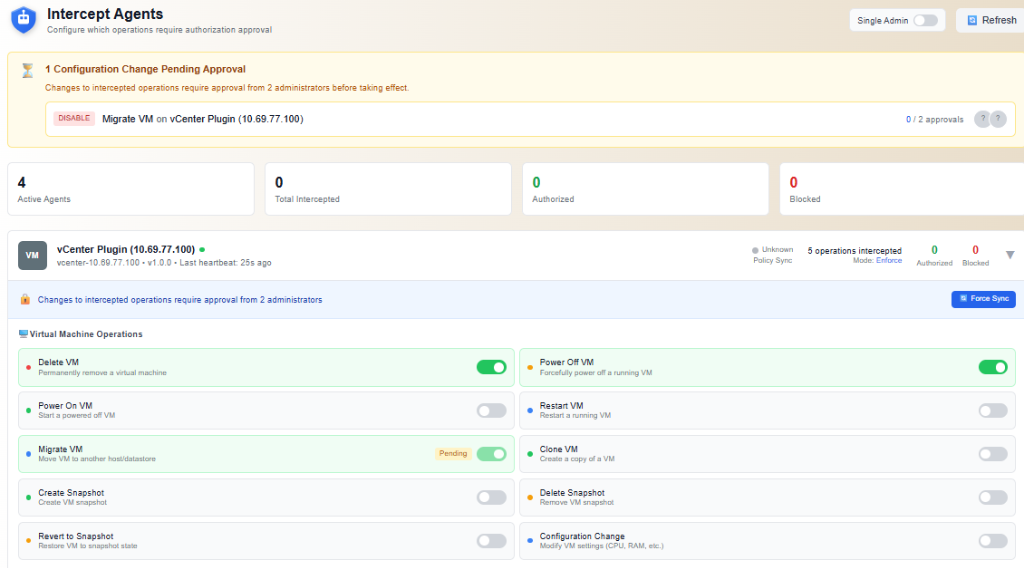
Native audit tells you what changed. Validation decides whether it may change.
Active Directory: Microsoft Event 5136 can identify the requesting account, object, attribute, operation, and value context for an audited modification.
Windows: Microsoft Event 4657 can record the process and old/new value context for an audited registry modification.
Linux: Red Hat states that Linux Audit can reveal policy violations but does not itself add preventive security.
vCenter: Broadcom exposes virtual-infrastructure lifecycle operations through the vSphere management API.
AuthorityGate's role: connect those platform signals and control points to ticket scope, eight-gate validation, a named authority decision, constrained execution, and an immutable evidence chain.
AuthorityGate turns AI governance from a policy document into an operating decision
01
ObserveResolve the real actor, action, target, and context at the point of change.
02
ValidateTest identity, security, dependencies, behavior, approval, and recovery.
03
ConstrainBind approval to the smallest useful scope and a limited execution window.
04
ProveLink intent, evidence, authority, execution, drift, and outcome in one record.
This is the AuthorityGate validation model: policy defines the boundary, technical gates test the action, human authority resolves consequential risk, and enforcement ensures the decision survives contact with production.
Each gate asks one decision-grade question
A gate is not a meeting. It is an evidence requirement with a pass, hold, escalate, or block outcome. Configure depth and routing to the risk of the action.
Establish a known-good starting point before the action is allowed to move.
Pre-Validation & Backup
Do we know the current state, the risk tier, and that recovery data is usable?
Target baseline, change intent, risk classification, backup timestamp, and restore-test status.
Hold. Repair the evidence gap or create and test a recoverable backup.
Keep autonomous execution inside approved operating conditions.
ITSM Window Check
Is this action linked to an approved request and allowed to execute now?
ITSM record, maintenance window, blackout calendar, target list, and request expiry.
Hold. Reschedule or obtain an explicitly approved exception.
Prove the identity, authority, and exact scope of the human or machine actor.
Zero Trust Verification
Is this actor explicitly authorized for this action on this target right now?
Actor identity, credential state, role, session, target scope, and least-privilege policy result.
Block. Revoke or narrow access; do not inherit authority from the deployment context.
Reject known threats, unsafe artifacts, and policy violations before execution.
Security Scanning
Is the payload, configuration, or instruction safe enough to test further?
Signature and provenance, vulnerability scan, malware result, SBOM, and policy-as-code output.
Block. Quarantine the artifact and route the finding to the security owner.
Prevent a locally safe change from creating a system-wide failure.
Dependency Health
Are upstream, downstream, and concurrent dependencies healthy and compatible?
Dependency graph, service health, compatibility result, active-change conflicts, and owner notice.
Hold. Resolve dependency health or isolate the blast radius before proceeding.
Observe what the change actually does in a representative lower environment.
Behavioral Resilience
Does behavior remain inside the approved baseline after the change?
Before/after telemetry, regression results, deviation thresholds, test context, and confidence score.
Block or escalate. Investigate the deviation; never average away a critical signal.
Reserve business intent and consequential risk acceptance for a named human.
SME Approval
Does an accountable expert accept the intent, evidence, and residual risk?
Gate summary, risk rationale, named approver, decision, conditions, timestamp, and expiry.
Hold or reject. Escalate by policy; never convert silence into approval.
Make recovery a condition of execution instead of an activity invented during failure.
Recovery Readiness
Can the organization reverse or contain the action inside business tolerance?
Tested rollback, validated backup, RTO/RPO fit, recovery owner, trigger, and communication path.
Hold. Prove the recovery path or reduce the action to a safely reversible scope.
Important: The order is a default operating sequence, not a claim that every organization must implement identical controls. Gates may run in parallel where dependencies permit, but an action should not execute until every control required by its policy and risk tier has resolved.
Use risk tiers to decide where humans belong
The goal is not zero autonomy. The goal is bounded autonomy: machine-speed decisions inside pre-approved limits, human authority at consequential boundaries.
Routine
- Qualification
- Reversible, narrow scope, no sensitive data, no privilege change, no critical service.
- Execution path
- Automated gates; proceed only when every required gate passes.
- Human authority
- Policy owner reviews the class of change, not every instance.
Elevated
- Qualification
- Moderate blast radius or service degradation is possible; recovery is straightforward.
- Execution path
- Automated gates plus notification or single approval when a policy trigger fires.
- Human authority
- Service owner or delegated SME.
High
- Qualification
- Touches privilege, sensitive data, customer experience, or a business-critical service.
- Execution path
- Named SME approval before execution, staged release, and staffed recovery window.
- Human authority
- System SME and accountable risk owner.
Critical
- Qualification
- Irreversible, safety-relevant, regulated, enterprise-wide, or materially financial.
- Execution path
- Multi-party approval, constrained canary, explicit stop conditions, and tested rollback.
- Human authority
- Executive risk owner plus technical authority.
Escalate a tier when any boundary changes
This is an AuthorityGate recommended starting model, not an empirical benchmark. Calibrate it to enterprise risk tolerance, legal obligations, system criticality, and recovery capability.
Build one minimum evidence packet
Logs prove that something happened. Decision evidence explains who or what acted, what was evaluated, why the action was allowed, and how the organization could recover.
Human, agent, service account, pipeline, and credential identity.
Business purpose, expected result, and policy basis.
Exact diff, artifact, command, tool call, or configuration.
Targets, environment, dependencies, data, and blast radius.
Approved time, expiry, freeze state, and execution duration.
Gate results, telemetry, scans, tests, and exceptions.
Named approver, decision rationale, conditions, and timestamp.
Rollback, RTO/RPO, trigger, owner, and communications.
The reconstruction test
Ask an independent reviewer to reconstruct the action six months later without opening the agent conversation. The record passes only if the reviewer can answer:
- 1.What business outcome was intended?
- 2.Which actor had authority, and where did that authority end?
- 3.Which policy and risk tier applied at decision time?
- 4.What technical evidence supported the decision?
- 5.Which human accepted residual risk, if one was required?
- 6.What executed, what happened, and could it be reversed?
Measure coverage, control quality, and recovery
Avoid a dashboard that counts agents but cannot show authority. These measures expose whether governance is reaching production and whether exceptions are weakening it.
| Metric | Formula | Executive question answered |
|---|---|---|
| AI inventory coverage | Registered AI actors / discovered AI actors x 100 | Can we see the population we intend to govern? |
| Validation coverage | Gated production actions / all production actions x 100 | How much change can bypass policy enforcement? |
| Interception coverage | Protected paths with a healthy interceptor / discovered protected paths x 100 | Where can a change still reach impact without an inline decision? |
| Missing-ticket containment | Held or blocked no-ticket attempts / no-ticket protected attempts x 100 | Do protected changes actually fail safe when governance is absent? |
| Unknown-agent rate | New unregistered actors / all actors discovered x 100 | Is shadow autonomy growing or shrinking? |
| Gate failure rate | Failed evaluations at gate / evaluations at gate x 100 | Where is risk entering the system? |
| Grant drift rate | Revoked or out-of-scope grants / active execution grants x 100 | Does authority remain bounded after approval? |
| Decision latency | Median time from escalation to named decision | Can human authority keep pace where it is needed? |
| Evidence completeness | Complete decision records / governed actions x 100 | Can a reviewer reconstruct why execution occurred? |
| Recovery readiness | Actions with tested rollback / actions requiring rollback x 100 | How often is recoverability proven before execution? |
| Override rate | Manual overrides / gated actions x 100 | Are exceptions becoming the operating model? |
A blended average can hide weak control over critical actions.
An action outside the gates is not a successful validation.
No universal percentage replaces enterprise risk tolerance.
A focused 90-day CISO plan
Start with a bounded production problem, prove the control loop, and then expand. The first milestone is not enterprise-wide policy; it is one action class that cannot bypass evidence-based authority.
Discover and bound
Outcome: A truthful inventory and explicit authority model.
- Inventory agents, service accounts, tools, targets, and owners.
- Select two high-value action classes; do not start with the whole enterprise.
- Define four risk tiers, prohibited actions, and accountable approvers.
- Capture the current bypass paths, evidence sources, and recovery gaps.
Pilot and challenge
Outcome: A working gate policy tested against real failure modes.
- Connect identity, ITSM, scanning, telemetry, and recovery evidence.
- Run the eight gates in observe-only mode before enforcement.
- Red-team goal hijack, tool misuse, privilege abuse, and cascading failure.
- Set pass, hold, block, and escalation rules by risk tier.
Enforce and report
Outcome: A measured control loop with named executive ownership.
- Enforce on the pilot action classes and remove known bypasses.
- Test rollback and the emergency stop path with the accountable teams.
- Review exceptions weekly; convert repeated exceptions into policy changes.
- Report coverage, latency, failures, evidence, overrides, and recovery readiness.
Connect the gates to existing governance language
The eight gates are an operating pattern. This crosswalk helps risk, security, operations, and audit teams connect the pattern to frameworks they may already use.
| Gate | NIST AI RMF | NIST CSF 2.0 | ISO 42001 cycle | OWASP Agentic Top 10 |
|---|---|---|---|---|
| G1 | GOVERN, MAP, MANAGE | IDENTIFY, RECOVER | Plan, Check | ASI08 Cascading Failures |
| G2 | GOVERN, MAP | GOVERN, PROTECT | Plan, Do | ASI10 Rogue Agents |
| G3 | GOVERN, MAP, MANAGE | PROTECT | Do, Check | ASI03, ASI07 |
| G4 | MEASURE, MANAGE | PROTECT, DETECT | Do, Check | ASI04, ASI05 |
| G5 | MAP, MEASURE | IDENTIFY, PROTECT | Plan, Check | ASI04, ASI08 |
| G6 | MEASURE, MANAGE | DETECT | Check | ASI01, ASI02, ASI06, ASI08 |
| G7 | GOVERN, MANAGE | GOVERN, RESPOND | Check, Act | ASI09, ASI10 |
| G8 | MANAGE | RESPOND, RECOVER | Act | ASI08 Cascading Failures |
Mapping note: This is AuthorityGate's interpretation for implementation planning. It is not an official crosswalk, certification, legal opinion, or endorsement by NIST, ISO, OWASP, CISA, or any survey publisher. Validate the mapping against the requirements and risk context that apply to your organization.
Twelve questions before autonomous execution
- 1Can we inventory the actor and its owner?
- 2Can we state the exact authority granted?
- 3Will a protected change stop when its ticket or scope is missing?
- 4Does a control-plane failure fail safely for this risk tier?
- 5Can we see the action before it executes?
- 6Can policy assign a risk tier consistently?
- 7Can the actor bypass any required gate?
- 8Can we test behavior in representative conditions?
- 9Can we stop and contain the action?
- 10Can a named human accept consequential risk?
- 11Can we reconstruct the decision from evidence?
- 12Can we recover inside business tolerance?
If any answer is "no," the action is not ready for unattended production authority.
Report outcomes, not control activity
What percentage of machine actors and production actions are inside the governance boundary?
Which high-impact decisions require a named human, and how often is that path used?
Which gates stop the most risk, and are recurring failures being removed at the source?
How many bypasses and overrides occurred, who accepted them, and when do they expire?
What percentage of consequential actions have a tested recovery path inside tolerance?
Frequently asked questions
What is autonomous AI change governance?
Autonomous AI change governance is the operating system of policies, identity controls, technical validation, human escalation, audit evidence, and recovery controls that decides whether an AI-initiated action may execute. It converts governance intent into an enforceable decision before production changes.
Why is a traditional Change Advisory Board not enough for AI agents?
A CAB is designed for human-paced review and scheduled change. AI agents can propose and execute actions continuously. Governance must therefore become machine-enforceable: routine actions are validated automatically, consequential actions stop for a named human, and every outcome remains traceable.
Does every AI action require human approval?
No. Human review should be risk based. Low-risk, reversible, tightly scoped actions can proceed when every required automated gate passes. High-impact, privileged, regulated, or irreversible actions should require a named human decision before execution.
What evidence should be saved for an AI-initiated change?
Preserve who acted, why the action was requested, the exact change, its targets and dependencies, the approved window, all validation results, the named human decision when required, and the tested recovery plan. The record should be sufficient to reconstruct the decision without relying on the model conversation.
How do the eight AuthorityGate gates relate to NIST AI RMF?
The gates operationalize outcomes across NIST AI RMF GOVERN, MAP, MEASURE, and MANAGE. They add decision points and evidence requirements around identity, context, testing, human authority, monitoring, and recovery. The mapping in this manual is an AuthorityGate interpretation, not a NIST endorsement or certification.
Where should a CISO begin?
Begin with discovery and a narrow pilot. Inventory machine actors and their authorities, select two production action classes, assign risk tiers and accountable owners, run the gates in observe-only mode, challenge them with real failure scenarios, and enforce only after the evidence path and rollback have been tested.
What is the AuthorityGate interception engine?
It is the enforcement layer that places a decision point in the path of protected changes. It resolves the actor, operation, target, risk, ticket, gate state, and approved scope, then returns allow, audit, hold, or block. The implementation differs by platform: protected-write control for Active Directory, an inline management path for vCenter, and scoped authorization grants with drift checks for Windows and Linux.
What happens when a protected change has no ticket?
The protected action does not receive authority to execute. Keystone creates or routes a governance work item, records the attempted actor and scope, and sends the request through the required validation and approval path. The action must be retried through the approved path; creating a ticket does not retroactively authorize the original attempt.
Does Keystone replace ServiceNow, Jira, or another ITSM platform?
No. Keystone maintains the validation and decision record and can link or route it to the enterprise ITSM workflow configured for the deployment. The ITSM system remains the system of engagement for change process; AuthorityGate is the enforcement and validation layer that prevents a ticket number alone from becoming authority.
Is change logging the same as change governance?
No. Native audit sources are essential for attribution and reconstruction, but they usually describe an event that was attempted or completed. Governance also requires a pre-execution decision: is the actor authorized, is the requested scope covered, did the required gates pass, and is recovery ready?
Does the interception engine block every operating-system change?
No product should make that claim. Enforcement applies to configured protected resources, operation types, and risk tiers. Lower-risk classes may run in audit mode, while protected classes can fail closed. Coverage, bypass paths, fail-safe behavior, and agent health must be measured and tested in each deployment.
What happens when an AuthorityGate agent or dependency is unavailable?
Availability behavior is policy driven. Protected, high-impact paths should fail closed or hold until authority can be re-established; lower tiers may be configured to audit. The deployment must test loss of connectivity, stale policy, emergency access, recovery, and reconciliation of any activity that occurred during an outage.
How does validation make AuthorityGate different from policy-only AI governance?
Policy states intent. Validation tests the requested action against identity, change context, security, dependencies, observed behavior, human authority, and recovery before impact. AuthorityGate then binds the decision to a narrow execution scope and records the result. That closes the operating loop between governance language and production behavior.
Does AuthorityGate certification guarantee compliance with NIST, ISO, or other frameworks?
No. AuthorityGate can produce evidence and operating controls that support an organization's control objectives, but compliance depends on scope, implementation, testing, legal obligations, and independent assessment. The crosswalk in this manual is implementation guidance, not certification or endorsement.
What is Operational Data Resilience?
Operational Data Resilience is the combined outcome of two necessary disciplines. Data resilience keeps trusted data backed up, intact, and recoverable. Operational resilience keeps critical business services available and behaving correctly through change. AuthorityGate does not position validation as a replacement for backup or disaster recovery; it connects prevention, bounded execution, and proven recovery so that both the service and its data are protected.
Why is human approval alone insufficient for vendor or AI changes?
A human can approve intent and accept residual risk, but cannot manually reproduce every dependency, inspect every machine-speed action, or predict runtime behavior from a ticket summary. Human authority remains essential for consequential decisions. Automated validation gives that human decision-grade evidence and prevents the approved action from expanding beyond its actor, target, operation, and window.
Why do ITSM and change-control vendors need independent validation?
ITSM and change-control platforms are essential systems of record and workflow, but they are also software. Their rules, integrations, agents, permissions, upgrades, and auto-approval logic can change production authority. Keystone validates both the payload routed through the platform and changes to the control plane itself, without replacing the enterprise ITSM process.
How does Keystone validate a third-party vendor change?
Keystone treats the vendor as the author, not as the final authority. It verifies artifact provenance and security, matches the change to an approved ticket and scope, checks dependencies, observes behavior against the organization's known-good baseline in a representative environment, routes consequential risk to a named human, and requires a tested recovery path before bounded release.
Sources and methodology
Primary sources are linked directly. Survey claims retain publisher, sample, date, and sponsorship context where available. Framework mappings and operating recommendations are AuthorityGate analysis.
- 1 ServiceNow: Enterprise AI Maturity Index 2026
Survey of 4,500 executives in 19 countries and 12 industries; reports 59% agentic AI use and 26% with governance and compliance systems.
- 2 Cloud Security Alliance: Autonomous but Not Controlled
January 2026 online survey of 418 IT and security professionals; commissioned and financed by Token Security with questionnaire co-development disclosed by CSA.
- 3 Okta: AI at Work 2025
Vendor research based on a survey of 260 executives; reports 91% using AI agents and 10% with a well-developed non-human identity strategy.
- 4 NIST: Artificial Intelligence Risk Management Framework Core
Primary framework for the GOVERN, MAP, MEASURE, and MANAGE functions used in the crosswalk.
- 5 NIST: Cybersecurity Framework 2.0
Primary source for GOVERN, IDENTIFY, PROTECT, DETECT, RESPOND, and RECOVER outcomes.
- 6 ISO: ISO/IEC 42001:2023
Official overview of the AI management system standard and its continual-improvement model.
- 7 OWASP GenAI Security Project: Top 10 for Agentic Applications
Primary taxonomy for agent goal hijack, tool misuse, identity abuse, supply-chain, execution, memory, inter-agent, cascading, trust, and rogue-agent risks.
- 8 CISA and UK NCSC: Guidelines for Secure AI System Development
Official secure-by-design guidance emphasizing ownership of security outcomes, transparency, and accountability.
- 9 NIST: SP 800-53 Rev. 5: Configuration Change Control
Primary control catalog. CM-3 covers change control, including testing, validation, documentation, and restricting changes under defined conditions.
- 10 Microsoft: Event 5136: A directory service object was modified
Primary Windows event reference showing the actor, directory object, attribute, operation, and old/new value context available for audited Active Directory modifications.
- 11 Microsoft: Event 4657: A registry value was modified
Primary Windows event reference showing the actor, process, registry object, operation, and old/new value context available for configured registry auditing.
- 12 Red Hat: RHEL 9: Auditing the system
Primary operating-system guidance: Linux Audit records security-relevant actions and policy violations, but Red Hat explicitly distinguishes audit visibility from preventive security controls.
- 13 Broadcom: VMware vSphere Web Services API Reference
Primary API reference for managing, monitoring, and controlling virtual-machine and virtual-infrastructure lifecycle operations through vSphere.
- 14 Splunk: The Hidden Costs of Downtime 2026
Vendor research based on 2,000 Global 2000 executives; reports average downtime cost of $15,000 per minute, $300 million per organization annually, and AI-related downtime reported by every technology leader surveyed.
- 15 Splunk and Oxford Economics: The Hidden Costs of Downtime 2024
Primary report based on 2,000 executives across 53 countries and 10 industries. Reports 466 cyber-related plus 456 application/infrastructure system-hours annually for a typical Global 2000 company, and average post-remediation recovery of 60 days for brand health, 75 for revenue, and 79 for stock price.
- 16 Veeam: The State of Data Backup: Trends in Resilience and Trust
Vendor survey summary reporting 54% recover lost data within one day, 36% require one to three days, and 56% experience operationally affecting downtime during recovery.
- 17 Veeam: Data Trust and Resilience Report 2026
Vendor research based on more than 900 senior IT, security, and risk leaders; reports 90% confidence in recovery, 72% of affected data recovered on average after ransomware, and 28% fully restoring data.
- 18 Uptime Institute: Annual Outage Analysis 2025
Primary research release reporting that third-party providers accounted for about two-thirds of tracked public outages over nine years, and 85% of human-error outages involved ignored or inadequate procedures.
- 19 Atlassian: Post-Incident Review: April 2022 outage
First-party incident review: a peer-reviewed script deleted 883 sites in 23 minutes; data loss was capped at five minutes, while service restoration lasted up to 14 days for some customers.
Find the first change your AI should not make alone.
We will map the actor, authority, evidence, gates, human decision, and recovery path around one real production workflow.