
AI Change
Validation
Change management tells you a change is allowed. Change validation proves it is safe. It is what AuthorityGate Keystone does - automatically verifying every patch, deployment, and AI-initiated action against your real environment before it reaches production.
What is change validation?
Change validation is the independent verification that a proposed change - a patch, configuration update, deployment, or AI-initiated action - is safe to apply before it reaches a production system. It runs in the gap between change approval (a CAB ticket or pipeline gate that says a change is allowed) and production deployment (where the change actually executes).
Traditional change management answers "is this change authorized?" Change validation answers the harder question: "will this specific change, against this specific environment, right now, actually behave safely?" AuthorityGate Keystone performs that verification automatically through a configurable 8-gate pipeline, escalating only the high-risk changes to a human.
The gap nobody is watching
Every enterprise already has testing, change management, and backup. But between CAB approval and production there is an unguarded gap - the moment a change stops being a ticket and becomes a live action. That gap is where 80% of unplanned outages are born: not from attackers, but from operational changes that were approved on paper and never validated in practice.
When changes were slow and human, the gap was tolerable. Now that AI agents and pipelines push changes at machine speed, the gap is the single most dangerous point in the enterprise.


Human governance can't run at machine speed
Your CAB reviews changes weekly. AI agents make changes in seconds. The only way to govern machine-speed change is to validate at machine speed too - with humans escalated in only where judgment is required.
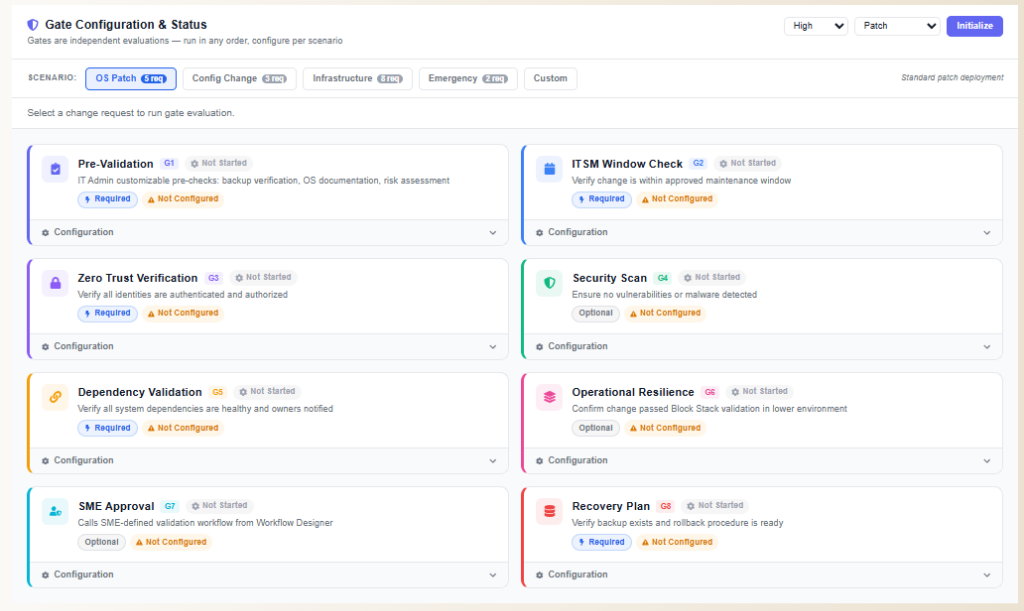
Eight gates between a proposed change and production
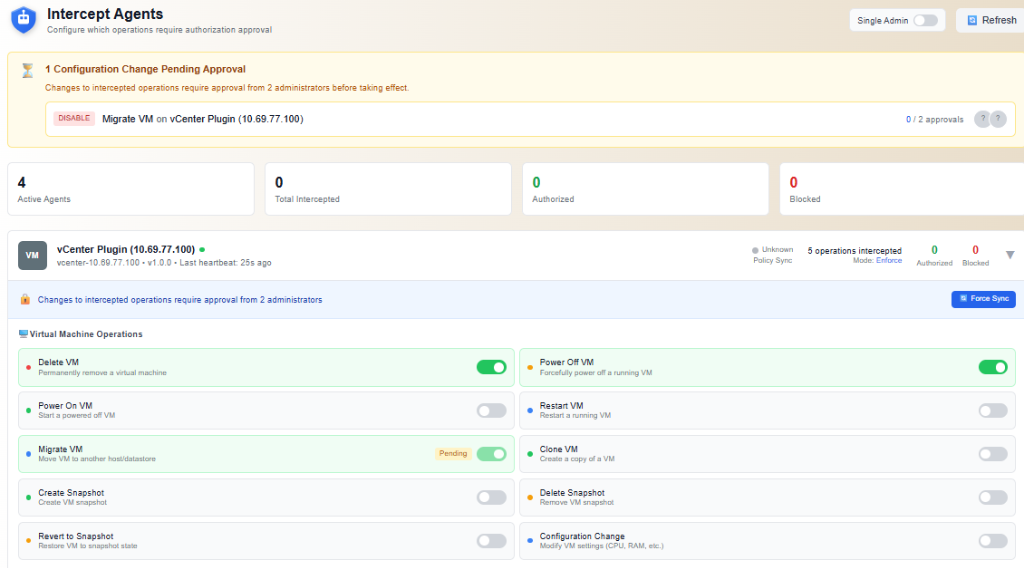
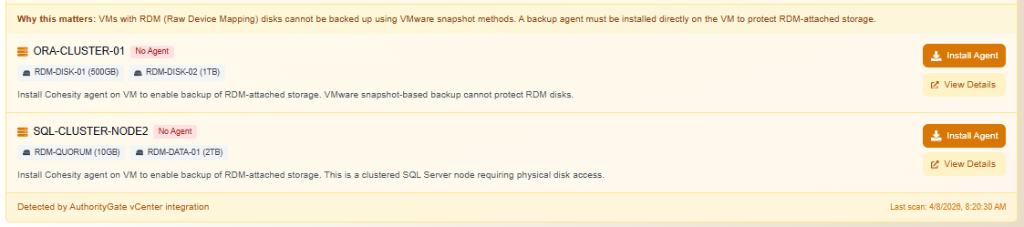
Every change - human, pipeline, or AI agent - passes through the same configurable Keystone pipeline. Low-risk changes clear all eight gates programmatically in seconds. High-risk changes stop at Gate 7 for a named human to decide. Each gate is independently tuned to your risk tolerance and compliance requirements.
Click any gate for the full detail and why it matters.
A named human on every consequential decision
Augmented, human-in-the-loop validation follows one pattern: AI analyzes, a human validates, the system executes. The AI handles behavioral analysis, risk scoring, and anomaly detection at machine speed. A subject-matter expert applies judgment and makes the final go/no-go call before any consequential action runs.
The result is faster than pure manual review and safer than pure autonomous execution - and there is always a person accountable for what reached production.
AuthorityGate calls this enforced Gate 7 SME approval its Human in the Middle (HITM) checkpoint: the named expert sits in the execution path, not outside it.

Change management vs. change validation
They are complementary, not competing. Change management governs permission. Change validation proves safety. Keystone is the validation layer most enterprises are missing.
| Change Management | Change Validation | |
|---|---|---|
| Core question | Is this change authorized? | Will this change behave safely? |
| When it runs | Before approval | After approval, before production |
| Operates on | A ticket / request | The actual change vs. the actual environment |
| Speed | Human cadence (weekly CAB) | Machine speed, seconds per change |
| Handles AI agents | Not designed for autonomous change | Validates human, pipeline, and agent changes alike |

Every change, fully traceable
Each gate outcome is logged with full context for every change. When a change escalates, both the AI-generated risk assessment and the named human's approval are recorded. The result is a complete, tamper-evident chain from request to execution - so when an auditor or regulator asks who approved this and why, the answer is traceable and complete, even when an AI agent proposed the change.
Change validation, answered
What is change validation?
Change validation is the practice of independently verifying that a proposed change - a patch, configuration update, deployment, or AI-initiated action - is safe to apply before it reaches a production system. It sits between change approval (a CAB ticket or pipeline gate that says a change is allowed) and production deployment (where the change actually executes). Traditional change management answers "is this change authorized?" Change validation answers the harder question: "will this specific change, against this specific environment, right now, actually behave safely?" AuthorityGate Keystone performs that verification automatically through a configurable 8-gate pipeline with human-in-the-loop escalation for high-risk changes.
How is change validation different from change management?
Change management is the governance process - request, review, approve, schedule, and record changes (typically via a Change Advisory Board and an ITSM tool). It establishes who is allowed to change what and when. Change validation is the technical verification layer that runs after approval and before execution: it analyzes the actual change against the actual target environment, scores its risk, tests its behavior in a lower environment, and either auto-clears low-risk changes or escalates risky ones to a human. Change management says a change is permitted; change validation proves it is safe. AuthorityGate Keystone is the validation layer in the gap between CAB approval and production.
Why do AI agents make change validation urgent?
Agentic AI systems no longer just recommend changes - they execute them autonomously, at machine speed. A Change Advisory Board reviews changes weekly; AI agents can make thousands of changes per day in seconds each. Human governance running at human speed cannot review machine-speed deployments, so organizations face a choice between blocking AI's value or letting unvalidated changes reach production. Automated change validation resolves that trade-off: every change - human, pipeline, or agent - passes through the same verification gates in seconds, with a human pulled in only for the high-risk decisions that warrant judgment. Gartner projects that by 2028, 40% of Fortune 1000 companies will face concerns over losing control of AI agents pursuing misaligned goals.
Does change validation slow down deployments?
No - that is the point of automating it. Routine, low-risk changes pass the validation gates programmatically in seconds and are auto-approved, so they move as fast as the pipeline or agent that produced them. Only changes whose risk score crosses a configurable threshold are escalated to a subject-matter expert, and that reviewer receives AI-synthesized risk scoring, behavioral comparison results, and every prior gate outcome - so the human decision is fast and well-informed. You get pipeline speed for the 95% of changes that are safe and human judgment for the few that are not.
What kinds of changes can AuthorityGate Keystone validate?
Keystone validates any change that could reach a production system: OS and security patches, application and firmware updates, configuration changes, infrastructure-as-code, and virtualization operations across VMware, Citrix, Omnissa, AWS, and Azure - whether the change is initiated by a human operator, a CI/CD pipeline, or an agentic AI system. Each of the eight gates is independently configurable, so organizations match validation depth to the risk profile of each change type and to their compliance requirements.
How does change validation create an audit trail for AI decisions?
Every gate outcome - pre-checks, window verification, identity, security scan, dependency health, behavioral comparison, SME approval, and recovery readiness - is logged with full context for every change. When a change is escalated, the AI-generated risk assessment and the named human's approval are both recorded. The result is a complete, tamper-evident chain from request to execution: when an auditor or regulator asks who approved a change and on what basis, the answer is traceable and complete, even when the change was proposed by an AI agent.
Close the gap between approval and production
Change validation is one capability of AuthorityGate Keystone. We are selecting Founding Members for the invitation-only Early Access Program - bring Keystone to your VMware, Citrix, cloud, and agentic-AI environments before the next unvalidated change reaches production.