
Update
Validation
You don't write the updates you deploy - your vendors do. Update validation proves every patch, update, and firmware change is safe for your environment before it lands, instead of trusting that it is.
What is update validation?
Update validation is the independent verification that a software update - an OS patch, application update, firmware update, or vendor auto-update - is safe to apply to your specific environment before it reaches production.
It is distinct from update management, which schedules and distributes updates. Update management asks "is this update approved and deployed?" Update validation asks "will this update actually behave safely against my systems?" AuthorityGate Keystone answers the second question - for every update, automatically.
It was an update, not an attack
The largest IT outage in history wasn't a breach. A trusted vendor pushed a content update that crashed millions of machines at boot. Normal update management distributed it exactly as designed - because nothing validated its behavior against a live system first.
That is the gap update validation closes. A boot-level failure is unmistakable when the update is tested in a lower environment - and stopped there, before it ever reaches production.
Update management vs. update validation
Keystone doesn't replace your update-management stack - it adds the safety check it was never designed to perform.
| Update Management | Update Validation | |
|---|---|---|
| Core question | Is it approved and deployed? | Will it behave safely here? |
| Assumes the update is | Trusted (vendor-signed) | Unproven until tested |
| Tests real behavior | No | Yes - in a production mirror |
| Would have caught CrowdStrike | No | Yes |
Every update, proven before it lands
Keystone intercepts each update - vendor-pushed, scheduled, or AI-initiated - and runs it through the validation gates before it can deploy. Low-risk updates clear in seconds; risky ones stop for a human.
Backup & Baseline
Confirms a recoverable backup and a documented known-good baseline exist before the update is applied - so there is always a way back.
Integrity & Security Scan
Verifies the update package cryptographically (BLAKE3) and scans it for known vulnerabilities and tampering before it is trusted.
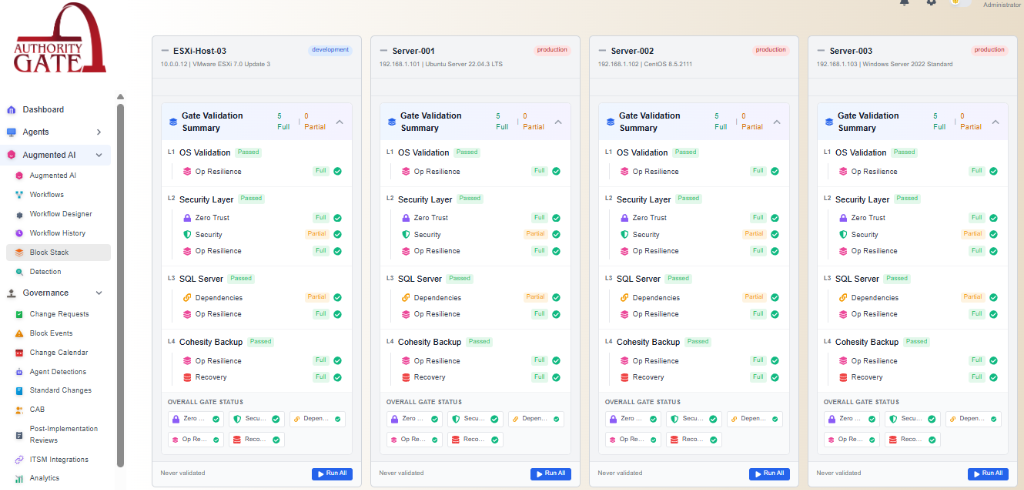
Behavioral Test (Block Stack)
Applies the update in a production-mirroring lower environment and compares behavior against a baseline - the gate that catches CrowdStrike-class failures.
Risk Score & SME Gate
Scores the update's risk against your environment; low-risk updates auto-clear, high-risk updates escalate to a named human with full context.
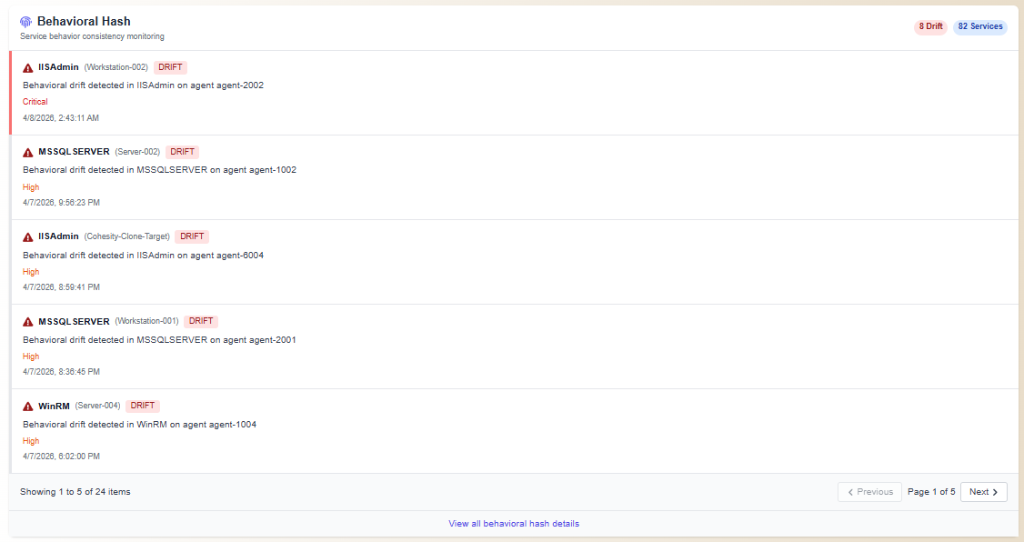
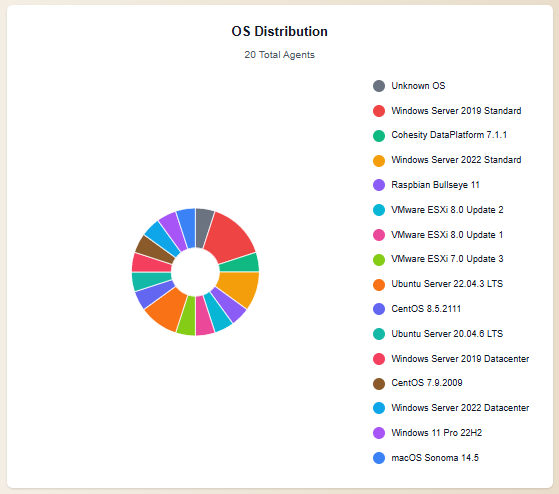
Update validation is one expression of Keystone's full 8-gate change validation pipeline - applied specifically to vendor updates.
The vendor patches we validate
You don't write the patches you deploy - your vendors do. Keystone validates each one against your environment before it lands, regardless of who pushed it. Coverage is growing; these are the stacks we validate today.
VMware
ESXi, vCenter & vSphereHypervisor and management-plane patches validated against your real cluster topology - catching driver and firmware incompatibilities, and HA/DRS disruptions, before a rolling update takes hosts down.
Microsoft
Windows Server, .NET & SQL ServerPatch Tuesday cumulative updates, framework, and database patches behaviorally tested in a lower environment - so the reboot loops, service regressions, and broken dependencies surface before deployment, not after.
CrowdStrike
Falcon sensor & channel filesAgent and rapid-response content updates intercepted and behaviorally validated against a production mirror - the exact class of update that crashed 8.5 million machines in July 2024.
Microsoft Defender
Platform, engine & definitionsAntivirus engine and security-intelligence updates validated so a definition push can't suddenly quarantine a critical business process or false-positive your own line-of-business software.
More vendors coming
Citrix, Adobe, Cisco, and your line-of-business applications are on the roadmap. Founding Members tell us their stack - and we validate it next.
Post-patch health verification
Validation doesn't stop at deployment. After a patch ships, Keystone re-baselines the system and confirms live behavior still matches known-good - so a patch that passed validation but degrades in production is caught immediately, with a tested rollback ready, instead of at the next incident.
Update validation, answered
What is update validation?
Update validation is the practice of independently verifying that a software update - an OS patch, application update, firmware update, or vendor-pushed change - is safe to apply to your specific environment before it reaches production. It is distinct from update (or patch) management, which schedules and distributes updates. Update management answers "is this update approved and deployed?" Update validation answers "will this update actually behave safely against my systems?" AuthorityGate Keystone validates each update by verifying its integrity, scanning it for risk, and testing its behavior in a production-mirroring lower environment before it is allowed to deploy.
How is update validation different from patch / update management?
Patch and update management tools (WSUS, SCCM/Intune, BigFix, and similar) are excellent at cataloging, scheduling, and distributing updates at scale - but they assume the vendor's update is safe and focus on getting it deployed. Update validation adds the missing verification step: before an update is distributed to production, Keystone checks its cryptographic integrity, scores its risk against your environment, and runs it in a lower environment to compare actual behavior against a baseline. Management answers logistics; validation answers safety. They are complementary, and Keystone is built to sit alongside your existing update-management stack.
Couldn't a single bad update still take us down - like CrowdStrike?
The CrowdStrike outage is the defining example of why update validation matters: it was not a cyberattack, it was a content update that crashed millions of Windows hosts at boot. The update was trusted and distributed by normal update management; nothing validated its behavior against a live system first. Keystone's Gate 6 applies each update in a production-mirroring lower environment and compares the resulting behavior against a known-good baseline - a kernel-level crash or boot failure shows up there as an unmistakable deviation and the update is stopped before it ever reaches production.
Does Keystone validate auto-updates and AI-initiated updates too?
Yes - and that is increasingly the point. Many updates today are pushed automatically by vendors or initiated by agentic AI systems without a human in the loop. Keystone intercepts every update regardless of who or what initiated it - human operator, automated agent, or vendor auto-update - and runs it through the same validation gates. Low-risk updates clear in seconds so you keep the speed of automation; high-risk updates escalate to a named subject-matter expert. You get current systems without surrendering control of what lands in production.
Stop trusting updates. Start validating them.
Update validation is one capability of AuthorityGate Keystone. Join the invitation-only Founding Members Early Access Program and validate every update before it reaches production.