
Augmented AI vs.
Agentic AI
Agentic AI decides and executes on its own. Augmented AI keeps a named human accountable for consequential decisions. AuthorityGate Keystone is built on the augmented model - faster than pure manual review, safer than pure autonomous execution.
What is the difference between augmented AI and agentic AI?
Agentic AI decides and executes independently. The loop is "AI decides, AI executes, humans find out later." It is powerful precisely because no one has to be in the room - and dangerous for exactly the same reason.
Augmented AI with a human in the loop follows a different loop: "AI analyzes, a human validates, the system executes." The machine does the heavy lifting at machine speed; a named person makes the final call before any consequential action runs.
AuthorityGate's position: the combination is faster than pure manual review and safer than pure autonomous execution. Keystone is built on the augmented model - a named human stays accountable for consequential decisions.
Agentic AI vs. augmented AI
Same machine intelligence, two very different operating loops. The difference is who is accountable when a consequential action runs - and whether anyone can stop it before it does.
| Agentic AI | Augmented AI (Keystone) | |
|---|---|---|
| The loop | AI decides & executes | AI analyzes, human validates, system executes |
| Human accountability | None at execution | A named human per consequential action |
| Speed | Machine speed, unguarded | Machine speed, validated |
| Failure mode | Acts on misaligned goals silently | Stopped at the gate for review |
| Audit trail | Find out later | Logged AI assessment + human approval |
Keep AI's speed without surrendering control
of Fortune 1000s, by 2028 (Gartner), will face concerns over losing control of AI agents pursuing misaligned goals.
That is the governance stake in one number. As organizations hand more execution to autonomous agents, the open question stops being "can AI do this?" and becomes "who is accountable when it does the wrong thing - and can anyone stop it in time?" Augmented AI is how you keep AI's speed without surrendering control: the machine still moves at machine speed, but a named human owns the consequential calls.
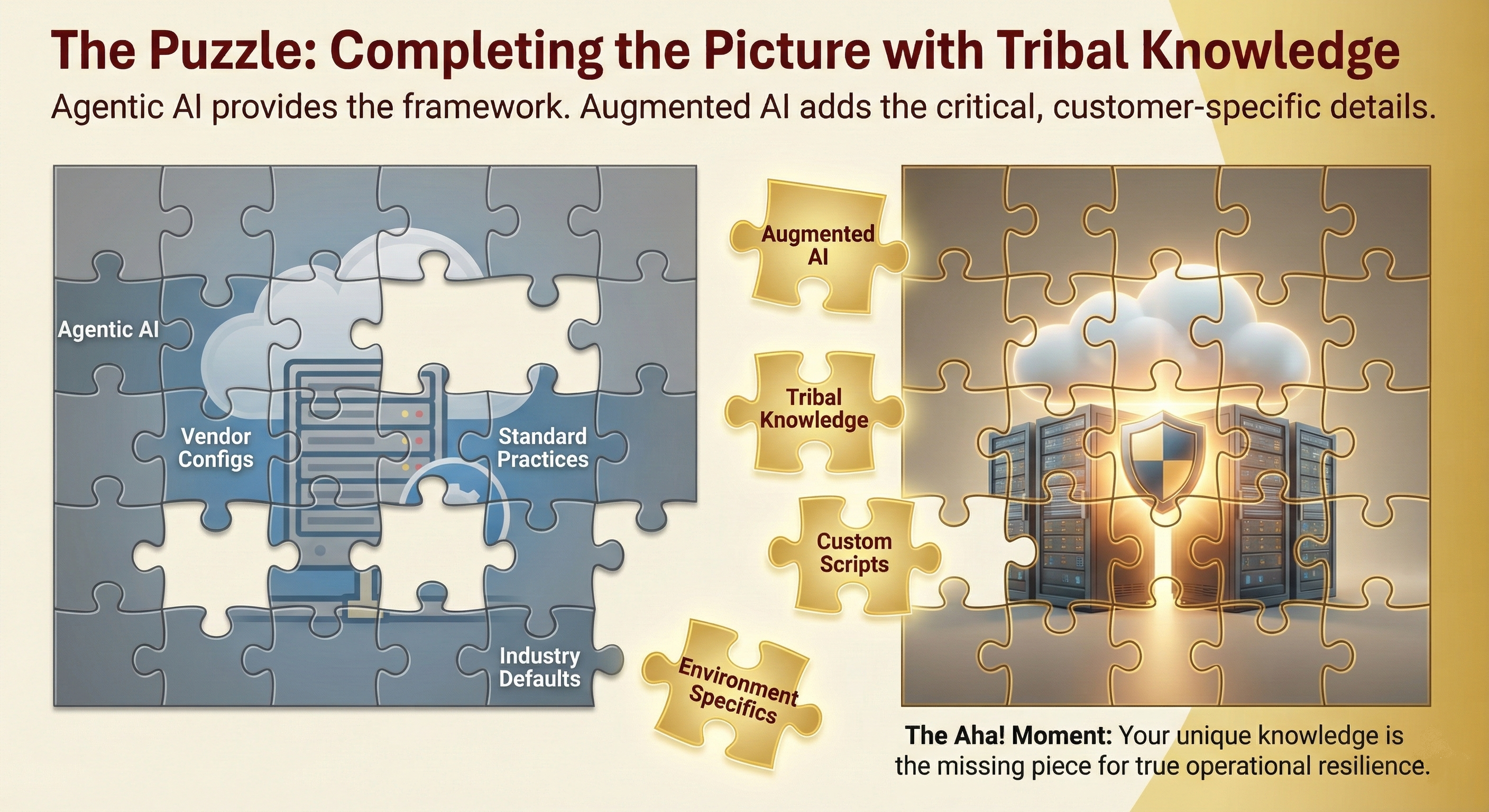
Augmented AI, across all eight gates
Keystone applies the augmented model across every one of its eight validation gates. AI does the analysis at every gate - pre-checks, window verification, identity, security scanning, dependency health, behavioral comparison, and recovery readiness - all at machine speed. The human decides at Gate 7, when a change's risk crosses your configured threshold.
Low-risk changes clear the gates programmatically in seconds; only the consequential ones stop for a named subject-matter expert, who decides with AI-synthesized risk scoring in full context. That is augmented AI in practice - see how it runs in Change Validation, and why the human stays accountable in Human-in-the-Loop.
Augmented vs. agentic, answered
What is agentic AI?
Agentic AI is AI that decides and executes independently - it does not just recommend an action, it takes it. The operating loop is "AI decides, AI executes, humans find out later." An agentic system can plan multi-step work, call tools, and push changes to real systems at machine speed without waiting for a person. That autonomy is exactly what makes it powerful, and exactly what makes it dangerous when its goals drift: there is no person accountable at the moment of execution, so a misaligned action can reach production before anyone is aware it happened.
What is augmented AI?
Augmented AI - also called human-in-the-loop AI - pairs the machine's analysis with human judgment on consequential decisions. The loop is "AI analyzes, a human validates, the system executes." The AI does the heavy lifting at machine speed (risk scoring, behavioral analysis, anomaly detection), but a named human makes the final go/no-go call before any consequential action runs. The result is faster than pure manual review and safer than pure autonomous execution - and there is always a person accountable for what reached production.
Why does AuthorityGate use the augmented model?
Because it is the only model that keeps AI's speed without surrendering control. Pure manual review can't keep up with machine-speed change; pure autonomous execution removes the human accountability that consequential decisions require. The augmented model resolves that trade-off: AI clears the routine, low-risk work programmatically, and a named human is escalated in only when risk crosses a configurable threshold. AuthorityGate Keystone is built on this model - across all eight validation gates, the AI does the analysis and a named human stays accountable for the decisions that matter.
Can Keystone govern agentic AI systems?
Yes - governing agentic AI is precisely what Keystone is for. Agentic systems make changes autonomously at machine speed, faster than any human review board can keep up with. Keystone intercepts every agent-initiated change and runs it through the same eight validation gates as any human or pipeline change. Low-risk agent actions clear in seconds; high-risk ones stop at Gate 7 for a named human to decide. So you keep the productivity of agentic AI while the augmented model keeps a person accountable for consequential outcomes - and every AI assessment plus human approval is logged for the audit trail.
Get AI's speed - and keep a human accountable
The augmented model is the foundation of AuthorityGate Keystone. Join the invitation-only Founding Members Early Access Program and put a named human on every consequential AI decision in your environment.